
In English, objects are neutral: a chair or a book is simply “it.” In Russian, everyday things carry more personality. A chair is a “he,” a book is a “she,” and a window is an “it.” Every noun naturally fits into one of three grammatical genders: masculine, feminine, or neuter.
While assigning gender to inanimate objects might feel unusual at first, it shapes everything from adjectives to past-tense verbs. Best of all, you rarely need to memorize these genders by heart, because in most cases, the ending of the word quietly reveals it to you. Let’s take a look at how these patterns work.
Why Noun Gender Matters
Knowing the gender of a noun is essential for two main reasons:
It determines the forms of surrounding words
The gender of a noun directly affects:
Pronouns: он (he), она (she), оно (it).
Adjectives: вкусный чай (masculine) / вкусная пицца (feminine) / вкусное яблоко (neuter).
Past Tense Verbs: Кот пил (masculine) / Кошка пила (feminine) / Солнце светило (neuter).
It helps you apply the correct case endings
Russian cases change noun endings based on their gender. Knowing whether a word is masculine, feminine, or neuter makes mastering case patterns simple and logical.
Noun Endings: General Rules
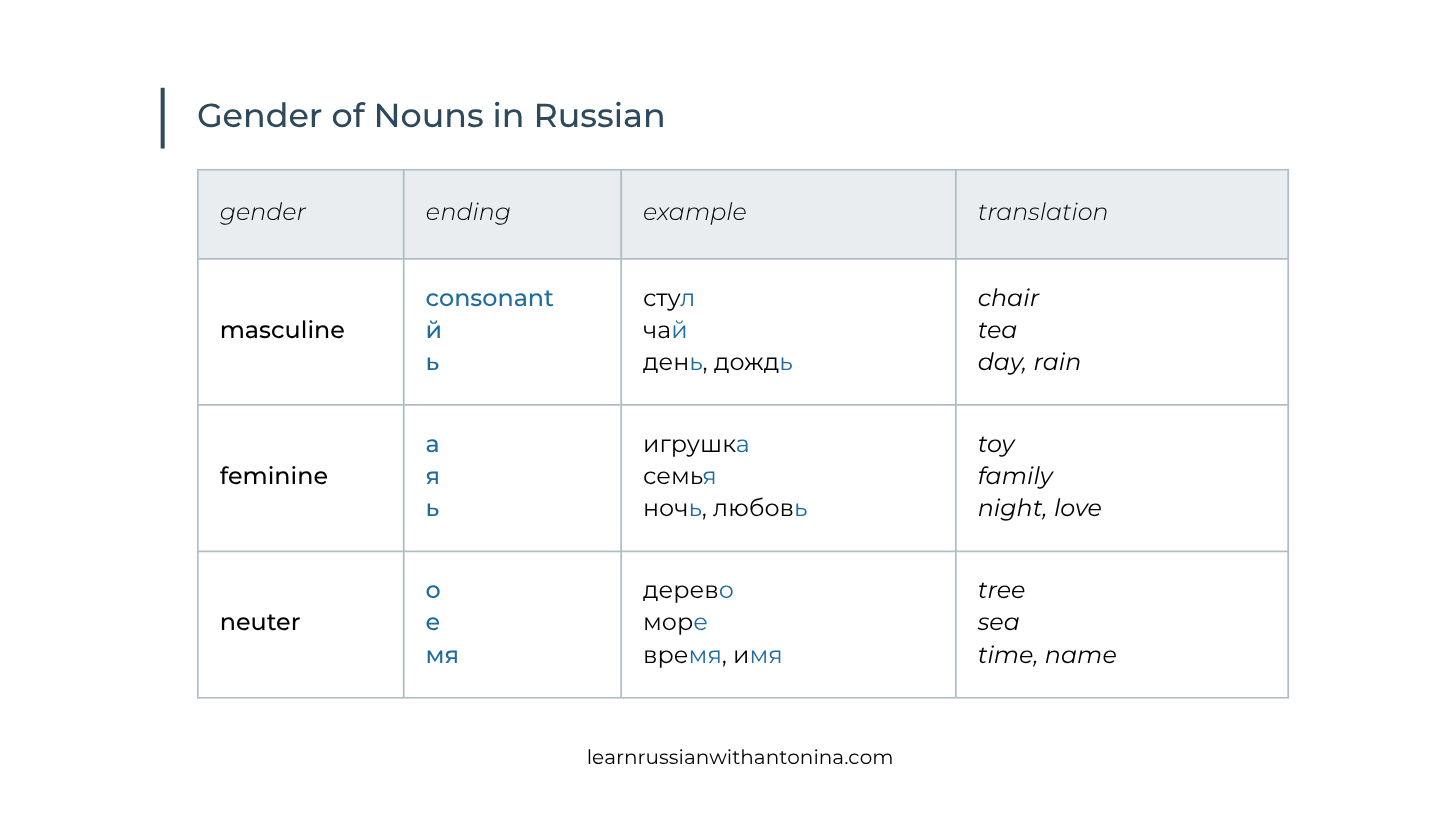
Below is an overview of how these ending patterns work using fruit vocabulary:
Masculine
бана́н — banana
лимо́н — lemon
апельси́н — orange
пе́рсик — peach
анана́с — pineapple
Feminine
гру́ша — pear
сли́ва — plum
клубни́ка — strawberry
мали́на — raspberry
ви́шня — cherry
Neuter
я́блоко — apple
авока́до — avocado
ма́нго — mango
поме́ло — pomelo
ки́ви — kiwi
Exceptions
While looking at word endings is the easiest way to determine gender, Russian has a few important exceptions to keep in mind!
• Male Family Members (-а / -я)
Words like па́па (dad), де́душка (grandfather), дя́дя (uncle), and мужчи́на (man) end in -а or -я, which usually indicates feminine nouns. However, because they refer to biological males, they are grammatically masculine. Adjectives and pronouns agree with them in the masculine form (e.g., мой добрый папа).
• The Famous Drink Exception
Even though ко́фе (coffee) ends in -е (which is normally a neuter ending), it is historically and grammatically masculine.
• Nouns Ending in Soft Sign (-ь)
The soft sign is a bit tricky because it can be either masculine or feminine. There is no universal rule here, so it is always best to check new words in a dictionary (I highly recommend OpenRussian.org). You can also memorize them together with their gender as you learn:
Masculine: день (day), дождь (rain), гость (guest)
Feminine: ночь (night), любо́вь (love), тетра́дь (notebook)
Grammar in Action: Subject & Pronoun Agreement
Here is how using personal pronouns (он, она, оно) works in everyday sentences:
Masculine (Он)
Это бана́н. О́н лежи́т на столе́. (This is a banana. It is lying on the table.)
Э́то лимо́н. Где о́н? (This is a lemon. Where is it?)
We use он because банан and лимон are masculine nouns.
Feminine (Она)
Это гру́ша. Она́ о́чень сла́дкая! (This is a pear. It is very sweet!)
Э́то сли́ва. Где она́? (This is a plum. Where is it?)
We use она́ because груша and слива are feminine nouns.
Neuter (Оно)
Это я́блоко. Оно́ зелёное и спе́лое. (This is an apple. It is green and ripe.)
Э́то авока́до. Где оно́? (This is an avocado. Where is it?)
We use оно́ because яблоко and авокадо are neuter nouns.
Fluffy Little Practice
Determine the grammatical gender of each noun listed below and substitute it with the appropriate personal pronoun: он, она, or оно.
мали́на → ___
пе́рсик → ___
поме́ло → ___
ко́фе → ___
ви́шня → ___
анана́с → ___
Please leave your responses (1–6) in the comments section below for review and feedback.
Enjoying my content?
If my free Russian lessons are helping you, feel free to buy me a coffee and help me create more resources for learners.
Improve your Russian with personalized tutor support, without fixed schedules or live calls. Explore my Flexible Lessons, designed for busy learners who want to study on their own terms. Get personalized weekly tasks, individual voice feedback, and the freedom to learn whenever it fits your schedule.
© 2026 Antonina. All rights reserved. Thank you for learning with me.
Explore my study materials: Digital Workbooks