
Welcome to your cozy corner for learning Russian. Conjugation often feels like the trickiest part of starting your language journey, but it doesn’t have to be overwhelming. Once you notice a few simple patterns, Russian verbs begin to make total sense.
In this guide, we’ll walk through the essentials of Russian verb tenses step-by-step:
Present Tense: How to master the 1st and 2nd conjugation patterns.
Past Tense: The easiest tense in Russian with simple gender endings.
Future Tense: A simple guide to the compound future with imperfective verbs.
Together with clear tables, real examples, and stress marks, you’ll build your confidence at a calm, comfortable pace.
Present Tense
In Russian, the present tense is used to describe actions happening right now or regular habits. Unlike English, Russian doesn’t use auxiliary verbs like “do” or “am/is/are” — you simply attach the correct ending to the stem of the verb.
Russian verbs are divided into two main group patterns based on their infinitive endings: -ать / -ять verbs and -ить / -еть verbs.
First Conjugation (-ать / -ять Verbs)
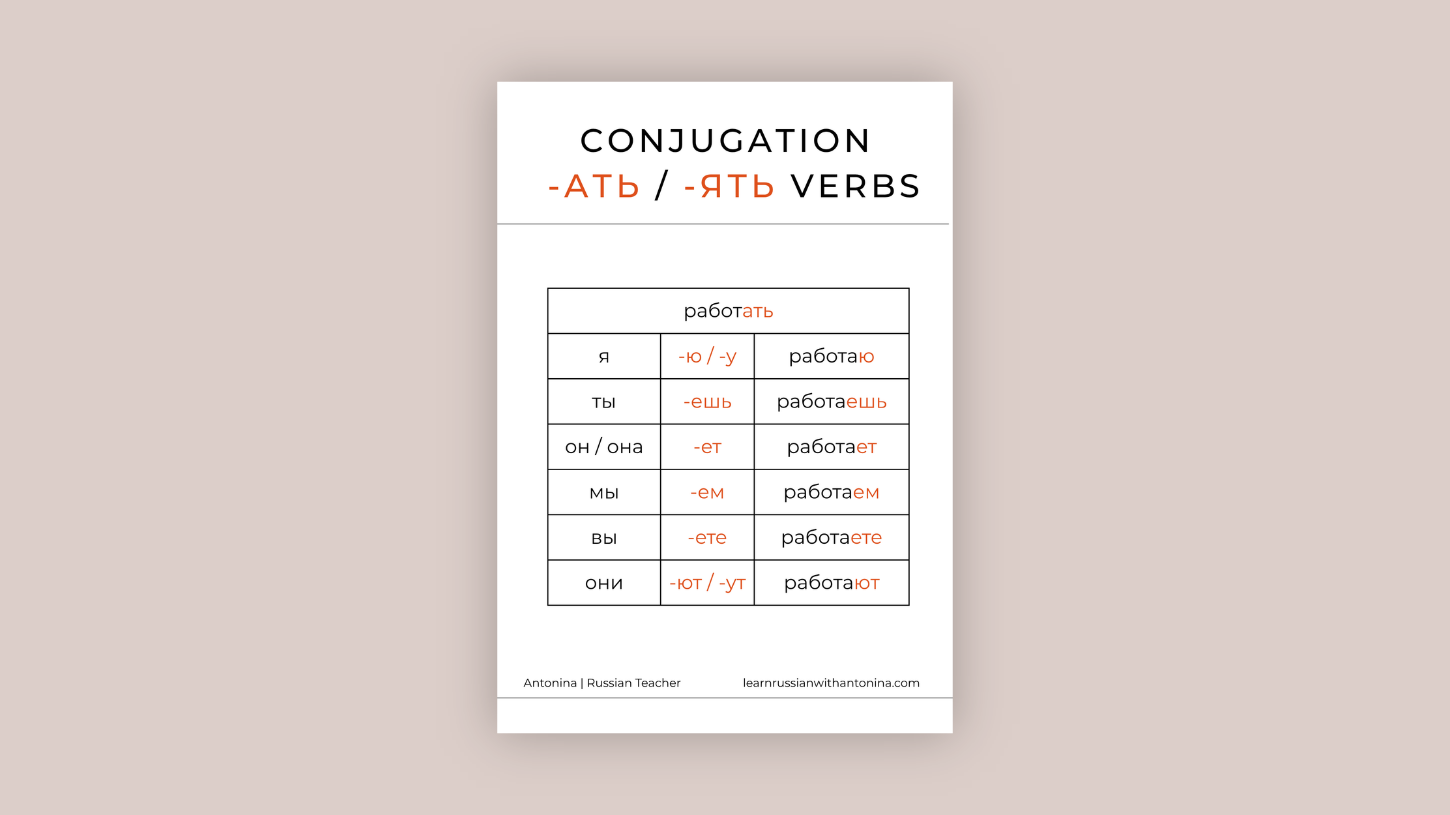
Most regular verbs ending in -ать or -ять follow the 1st conjugation pattern (for example, рабо́тать — to work).
To conjugate these verbs, drop the infinitive ending -ть and add the following personal endings:
Second Conjugation (-ить / -еть Verbs)
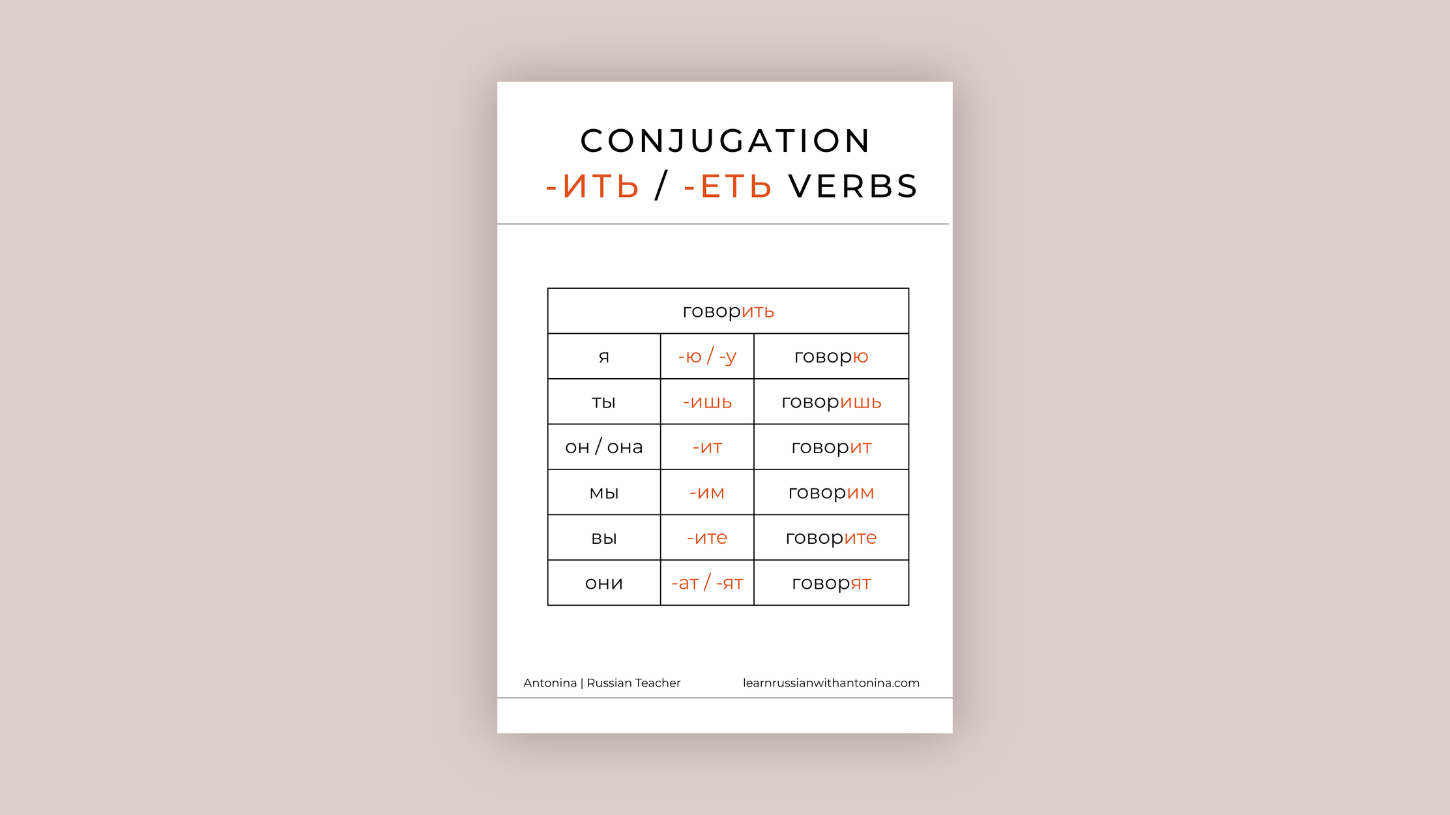
Most regular verbs ending in -ить or -еть follow the 2st conjugation pattern (for example, говори́ть — to speak).
To conjugate, drop -ть (and the vowel before it, if applicable) and add these endings:
Example Sentences
Я рабо́таю ка́ждый день. — I work every day.
Ты говори́шь по-русски? — Do you speak Russian?
Они́ рабо́тают вме́сте. — They work together.
Past Tense
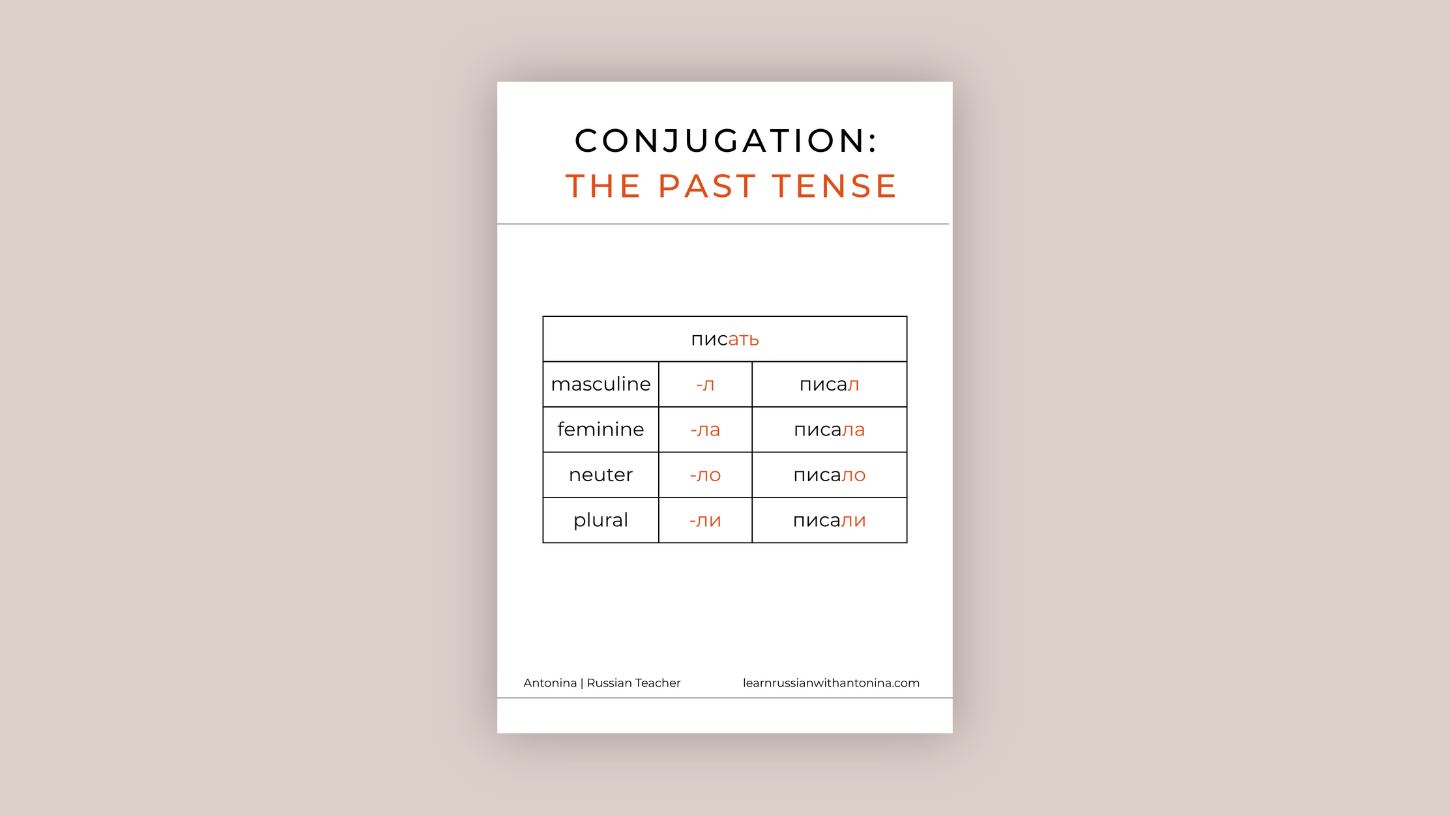
The past tense in Russian is wonderfully simple because verbs in the past tense do not change by person (there are no separate endings for I, you, we, or they). Instead, Russian past-tense verbs agree with the gender and number of the subject.
To form the past tense, take the infinitive verb, drop the -ть, and add the past tense suffix:
Example Sentences
Я рабо́тала весь день. — I (female) worked all day.
Он читал кни́гу вчера́. — He read a book yesterday.
Они́ говори́ли по-русски. — They spoke Russian.
Future Tense (Imperfective Form)
Unlike the present and past tenses, the future tense in Russian comes in two distinct forms: Imperfective (for ongoing, repeated, or process-oriented actions) and Perfective (for completed actions with a single result).
As a beginner, you don’t need to worry about the complexities of perfective verbs just yet — we will save those for later! For now, we will focus exclusively on the Imperfective Future (составное будущее время).
It is by far the easiest and most practical way for beginners to talk about future plans. Instead of memorizing new sets of verb endings, you simply combine the conjugated forms of the helper verb быть (to be) with the basic infinitive of your main action verb.
It works just like in English: “I will work” (я буду работать) or “We will read” (мы будем читать).
To make the future tense, conjugate the auxiliary verb быть (to be) for each person, and add the unchanged infinitive of your action verb:
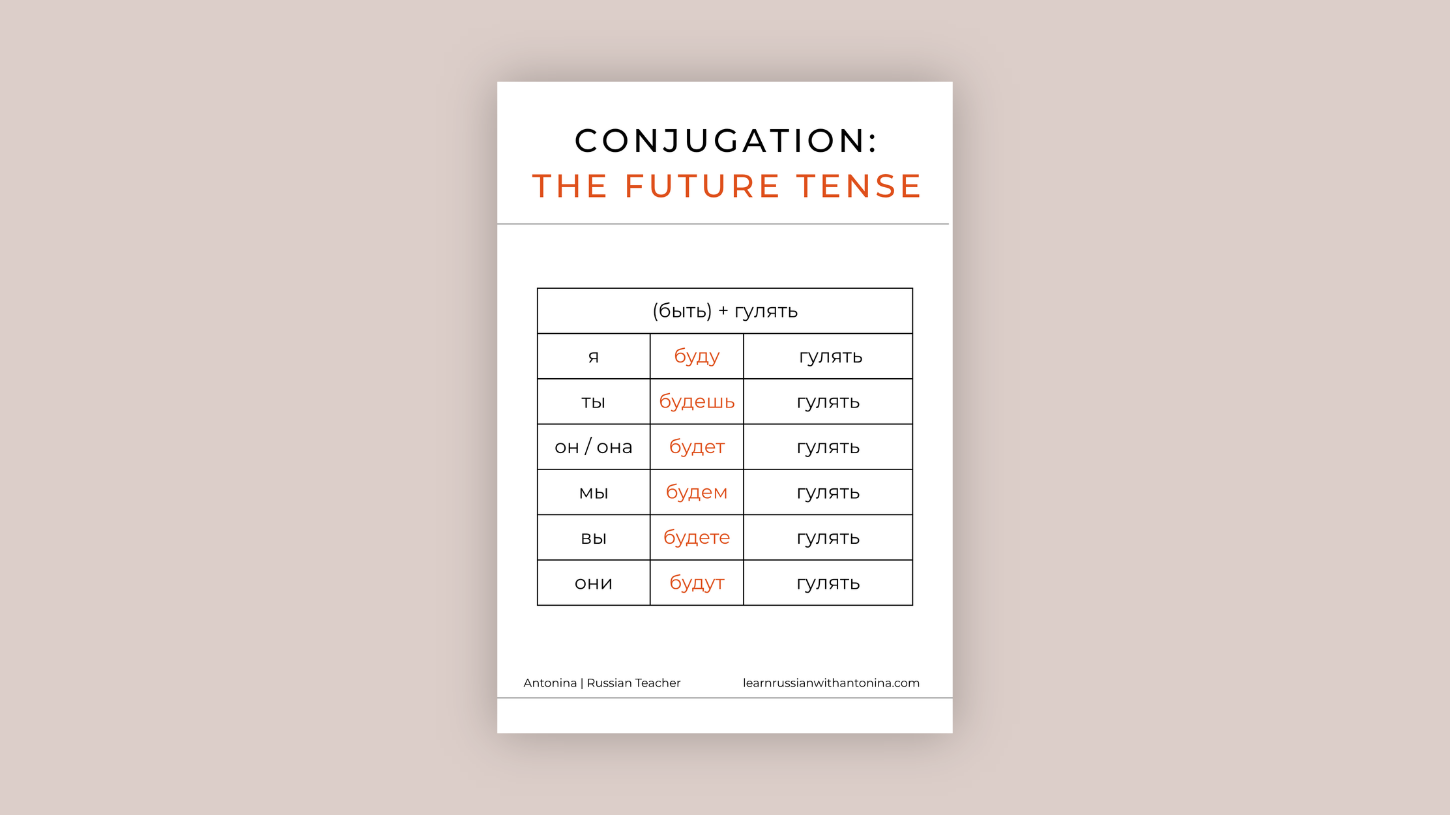
Example Sentences
Я бу́ду рабо́тать за́втра. — I will work tomorrow.
Ты бу́дешь учи́ть ру́сский язык? — Will you study the Russian language?
Они́ бу́дут отдыха́ть в конце́ неде́ли. — They will rest at the end of the week.
How to Study Russian Verbs: 2 Effective Methods
Every language learner has a different rhythm. Over years of offering flexible 1-on-1 lessons to my students, I’ve noticed that they usually fall into one of two learning styles when it comes to mastering Russian verbs:
Method 1: The Analytic Learner (Base Form First)
Some of my students prefer learning the basic infinitive (e.g., рабо́тать) and applying the conjugation rules step-by-step until it becomes second nature. This works great if you love grammar structures and logical patterns!
Method 2: The Holistic Learner (Full Conjugation Sets)
Other students in my lessons thrive by learning the verb together with its key conjugated forms right away (e.g., рабо́тать — я рабо́таю, ты рабо́таешь...). This helps build natural muscle memory so you can speak without stopping to calculate endings in your head.
Whichever method feels more comfortable for you, the key is consistent, stress-free practice. A great place to start is my article on the 50 Essential Russian Verbs for Beginners (complete with native audio recordings), where I use materials I created for my own students that support both learning approaches.
Take Your Practice: 50 Essential Verbs Flashcard Set
If you prefer a clean, visual way to learn, heavy textbooks and complex grammar apps can sometimes feel overwhelming. Having clear, beautifully organized verb cards makes daily review effortless.
My 50 Essential Russian Verbs Flashcard Set (digital PDF) is designed specifically to support both Analytic and Holistic learning styles, giving you a structured, bite-sized reference you can use on your tablet, phone, or print out if you like.
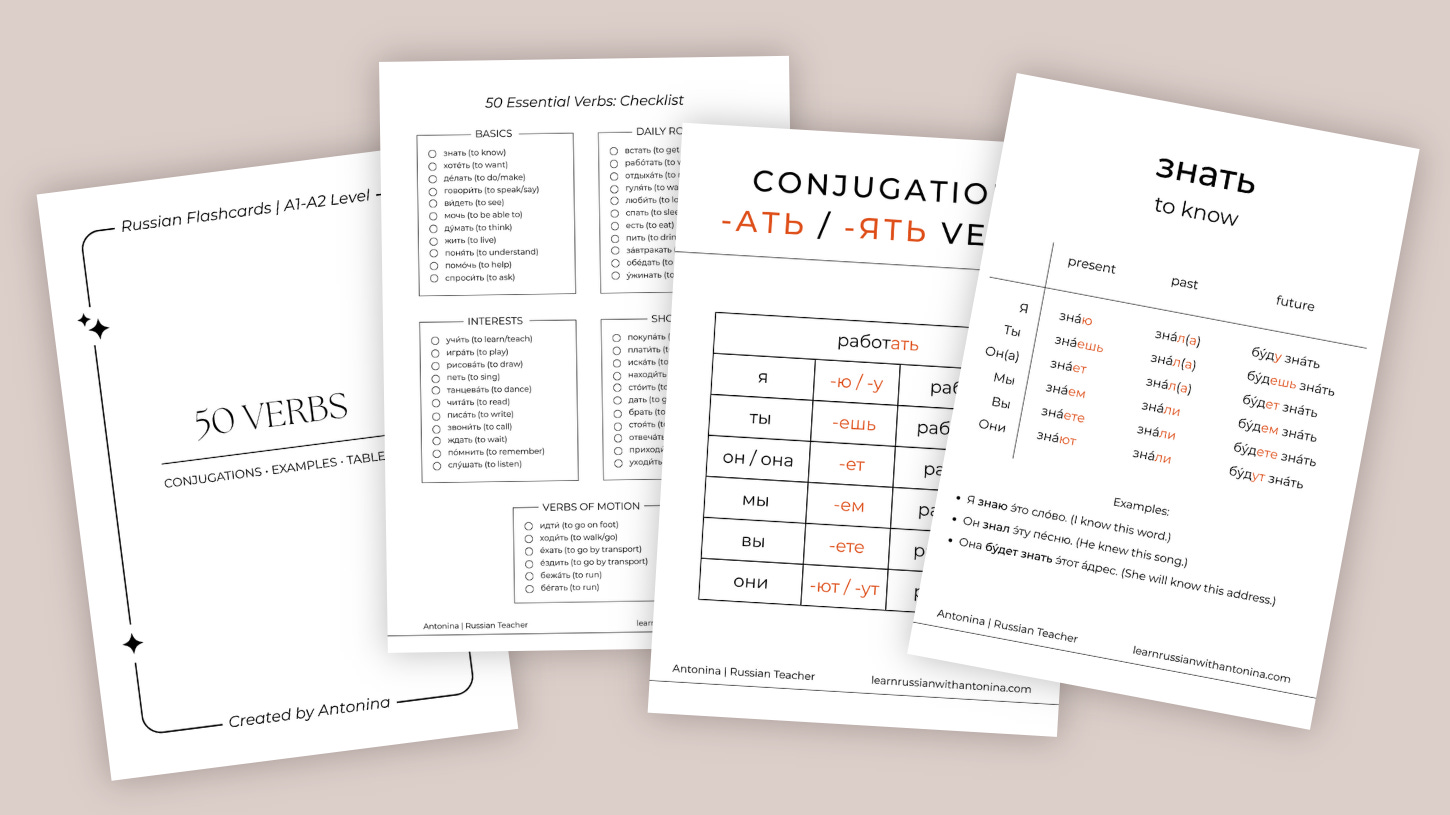
What’s Inside this Study Pack?
50 Essential Verbs: High-frequency verbs for everyday Russian, complete with accurate stress marks.
Full Conjugation Tables: Clear present, past, and basic future forms on every card.
150 Example Sentences: Three practical, natural examples for each verb to show how it works in real context.
Visual Grammar Guides: Intuitive, step-by-step explanations of common conjugation patterns.
Progress Tracker: A convenient layout to help you keep track of the verbs you’ve practiced and mastered.
Save them to your tablet or phone, review one verb a day with your morning tea, and build your Russian confidence gently at your own pace.

Let’s Practice Together!
Drop a comment below and practice with the verb знать (to know) using the ты (you informal) form!
Pick one tense (or try all three!) and complete these sentences in the comments:
Present: Ты ________? (Do you know?)
Past: Вчера ты ________? (Yesterday, did you know?)
Future: Ты ________ знать? (Will you know?)
Write your answers in the comments, and I’ll be happy to check them for you!
Enjoying my content?
If my free Russian lessons are helping you, feel free to buy me a coffee and help me create more resources for learners.
Improve your Russian with personalized tutor support, without fixed schedules or live calls. Explore my Flexible Lessons, designed for busy learners who want to study on their own terms. Get personalized weekly tasks, individual voice feedback, and the freedom to learn whenever it fits your schedule.
© 2026 Antonina. All rights reserved. Thank you for learning with me.
Explore my study materials: Digital Workbooks